
Chapter four · 2022–2024
Tele2Logged-in services
Two years shaping Tele2's logged-in web and app, from analysis and daily sketching to pixel-perfect handoff, through reorganisations and a platform change.
Areas
- Needs analysis
- Requirements analysis
- Concept development
- Customer journeys
- Information architecture
- Wireframes
- Prototypes
- Usability testing
- Design reviews
At a glance
- Problem
- Tele2's logged-in web and app had to keep meeting customers' needs while the business, the teams and the technical platform changed underneath them.
- Approach
- Ongoing needs and stakeholder analysis, A/B tests, daily sketching with other designers, prototypes, and usability tests every two to three months.
- Outcome
- Ten flows taken from wireframes to detailed, tested designs, including eSIM, Swish payments and e-invoice.
- 10flows designed, tested and delivered
- 2–3months between usability test rounds
- 2years on the logged-in experience
The assignment
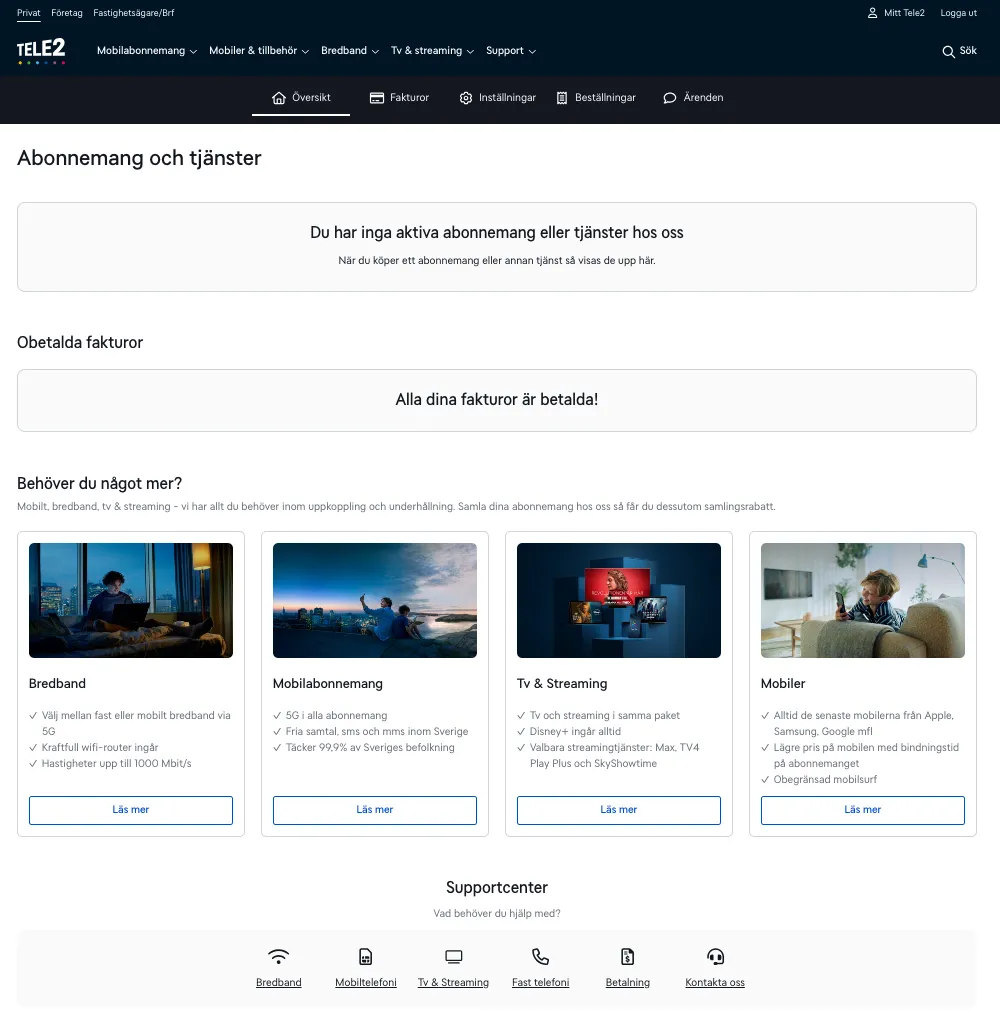
The assignment was to maintain and develop Tele2’s logged-in services: primarily the web, but also the app. I was part of a business team with a product manager, analysts, developers and content editors.
My job was to make sure customers’ needs were met and mapped against the business’s requirements and goals, while allowing for technical constraints.
Analysis to shape the interface
I regularly ran different kinds of analysis. For example, usability tests of the existing interface were turned into needs analyses.
A/B tests were driven by the wish to measure the effect of a change, and with it the impact on the business. To translate the business’s needs and requirements into design, I ran stakeholder and task analyses on an ongoing basis.
Sketches, concepts and prototypes
This was the core of my role. I sketched design concepts every day, on my own and together with other designers. Close collaboration is central to how I work.
As the designer, my main task was to turn the analyses and requirements into designs that could be handed over to developers. When the project called for it, I also built realistic prototypes: for presentations, as a basis for discussion, and for usability testing.
Evaluating and testing the product
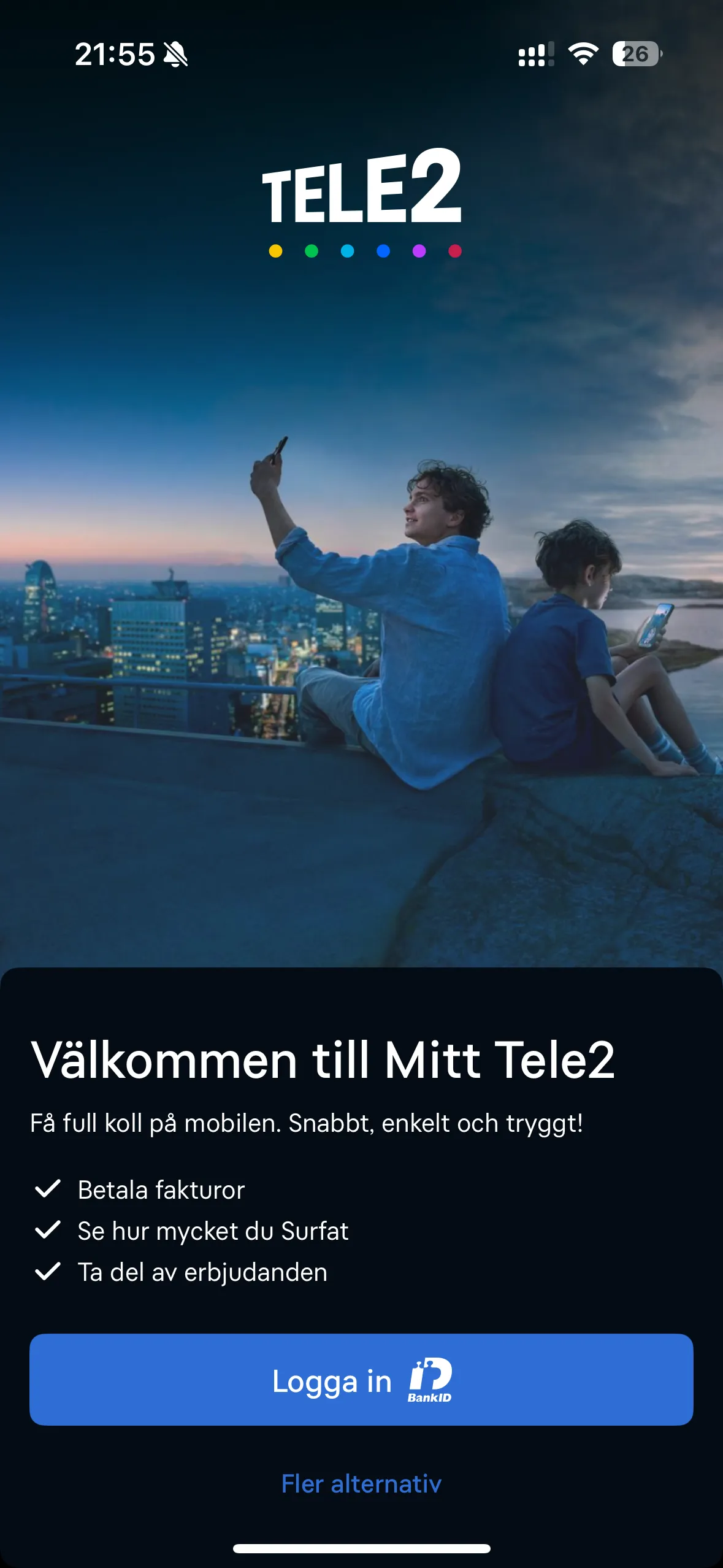
Usability testing of both existing and upcoming logged-in pages was a natural part of the work. On average we ran tests every two to three months.
I planned the tests, ran them (both moderating and observing) and analysed the results, to make sure the pages were easy to use and met the business’s needs and requirements.
What I designed
Among the features and flows I was responsible for, from wireframes and testing to detailed design:
- Activation and ordering flow for eSIM (app + web)
- Paying an invoice with Swish (app + web)
- Applying for e-invoice (app + web)
- Applying for direct debit (app + web)
- Updating contact details (web)
- Following an order and product delivery (web)
- Seeing broadband network status (app + web)
- Seeing and managing family subscriptions (web)
- Seeing and managing bundled products (web)
- Seeing and managing streaming and TV packages (web)
Challenges
A recurring challenge was the many reorganisations during the two years, which changed the teams several times. At the same time the business ran a transformation project, which I was closely involved in, to keep the user experience good throughout the technology shift. Timelines and priorities changed often, and I had to re-prioritise my own work quickly.
It was also a challenge to raise the importance of UX and design in the organisation. I repeatedly had to explain why design deserves extra time, and how testing and iterating early pays off for the business in the long run.
Result
I delivered design from early concepts to pixel-perfect detail across the projects and initiatives I was part of, working through the whole design process. I also pushed for close collaboration with developers and product owners, which everyone appreciated.